
The Spiritual Ego The Most Dangerous Mask
The spiritual ego is the sneakiest, most sophisticated, and most dangerous form of ego.
While the ordinary ego says “I am better than you,” the spiritual ego says “I am more awake than you.”
While the ordinary ego seeks money, status, or pleasure, the spiritual ego seeks enlightenment, purity, specialness, and the admiration of seekers. It is the ego wearing sacred clothes.
The spiritual ego is the sneakiest, most sophisticated, and most dangerous form of ego.
While the ordinary ego says “I am better than you,” the spiritual ego says “I am more awake than you.”
While the ordinary ego seeks money, status, or pleasure, the spiritual ego seeks enlightenment, purity, specialness, and the admiration of seekers. It is the ego wearing sacred clothes.
How the Spiritual Ego Operates
It is subtle. It hides behind beautiful words: “I have seen through the illusion.” “I am beyond ego.” “I don’t need anything anymore.” “My practice is deeper than yours.” “I am here to help you awaken.”
It collects spiritual experiences like trophies. It quotes masters. It meditates longer, reads more books, attends more retreats. It builds a new identity: “the conscious one,” “the teacher,” “the awakened,” “the one who has gone beyond.”
And the cruelest part? It can use genuine insight to strengthen itself. The moment you taste real freedom, the spiritual ego jumps in and says: “Look at me, I am free!”
This is why it is so dangerous. Ordinary ego is obvious. Spiritual ego is disguised as its own solution.
Common Manifestations
Spiritual superiority: Judging others as “unconscious,” “asleep,” or “still in ego.”
Spiritual bypassing: Using non-duality to avoid real human feelings, responsibilities, or pain (“It’s all illusion anyway”).
Guru identification: Needing students, followers, or admiration to confirm one’s awakened state.
Collection mentality: Accumulating experiences, insights, or lineages like spiritual currency.
False humility: “I am nobody… but let me tell you how nobody I am.”
Performance of stillness: Looking calm and wise while internally anxious about maintaining the image.
The spiritual ego is particularly tricky because it uses truth as its fuel. It speaks the language of the Enlightenment while still operating from separation.
The Middle Point Exposure
From the Middle Point, the spiritual ego is seen for what it is: just another layer of the same old game.
You do not fight it. You do not try to transcend it. You simply witness it with Double Arrow Attention.
See the one who wants to be “the conscious one.” See the one who needs to be seen as awakened. See the one who collects insights like spiritual gold stars.
When this is seen clearly, without judgment and without identification, the spiritual ego begins to dissolve. Not because you killed it, but because it is seen as another passing cloud in the sky of awareness. There is no “more spiritual” person. There is only awareness appearing as all of it.
The end of spiritual ego is not the end of teaching, helping, or sharing.
It is the end of doing any of it from a sense of specialness.
What remains is simple, ordinary, and extraordinarily alive: A human being who is no longer identified with being “a spiritual person.” Someone who can be wise in one moment and ridiculously foolish in the next. Someone who can speak truth and then laugh at the whole game. This is true freedom.
The spiritual ego dies not through effort, but through honest, ongoing seeing.
Every time you catch yourself wanting to be seen as awakened, special, or further along, smile. Laugh if you can. That laughter is the sound of the ego losing its grip.
In the end, the greatest spiritual realization is this: There is no spiritual person. There is only the One, playing all the roles, wearing all the masks, and sometimes laughing at how seriously It took the whole thing.
Welcome to the other side of the game.
Now go make a stupid joke. It’s good for the soul.
Ivan Rados — The Middle point
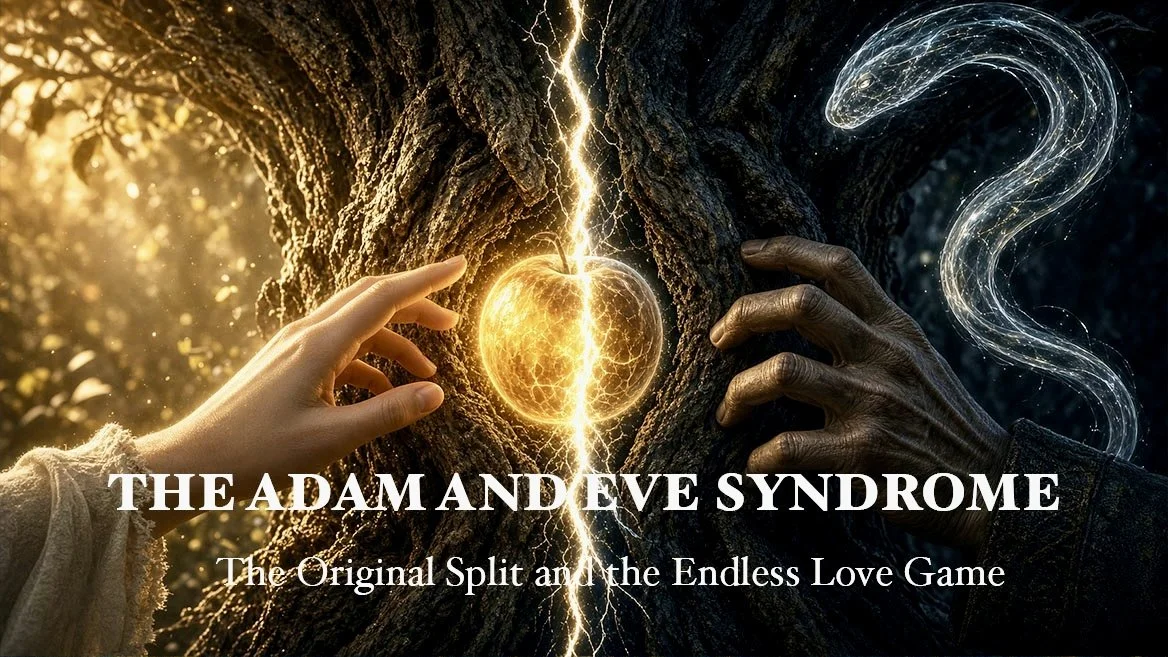
The Adam and Eve Syndrome
There is a pattern that repeats itself in almost every intimate relationship. It is so common, so deeply woven into the fabric of how men and women relate, that most people never question it. They simply live inside it, generation after generation, as if it were the natural order of love.
I call it the Adam and Eve Syndrome.
It is not about religion. It is not about believing or not believing in the biblical story. The story of the Garden of Eden is one of the most precise maps ever given of how consciousness leaves the Middle Point and falls into the endless swing of dualistic roles. Once you see it clearly, you begin to recognise it everywhere — in your own relationships, in the arguments that never truly end, in the quiet resentments, in the moments of sudden distance, in the cycles of guilt and blame that seem to have a life of their own.
The Adam and Eve Syndrome — The Original Split and the Endless Love Game
There is a pattern that repeats itself in almost every intimate relationship. It is so common, so deeply woven into the fabric of how men and women relate, that most people never question it. They simply live inside it, generation after generation, as if it were the natural order of love.
I call it the Adam and Eve Syndrome.
It is not about religion. It is not about believing or not believing in the biblical story. The story of the Garden of Eden is one of the most precise maps ever given of how consciousness leaves the Middle Point and falls into the endless swing of dualistic roles. Once you see it clearly, you begin to recognise it everywhere — in your own relationships, in the arguments that never truly end, in the quiet resentments, in the moments of sudden distance, in the cycles of guilt and blame that seem to have a life of their own.
The Garden Was the Middle Point
In the original state, before the fall, there was no separation. Adam and Eve lived in the Garden. The Garden is not a place. It is a state of consciousness — pure awareness, undivided, without the knowledge of good and evil, without the split between “me” and “you,” without the need to be right or the fear of being wrong.
In the Garden there is no guilt. There is no shame. There is no one to accuse and no one to defend. There is simply being. Presence. The Middle Point.
Then something happens.
They eat from the Tree of the Knowledge of Good and Evil. This is not a moral failure. It is the birth of the dualistic mind. The moment consciousness begins to divide experience into opposites — good and bad, pure and impure, innocent and guilty, me and the other — the Garden is left behind. Not because anyone is thrown out, but because the mind has created a new reality of separation.
Suddenly there is an “I” who can be wrong. Suddenly there is a “you” who can be blamed. Suddenly there is something to hide. Suddenly there is something to protect.
This is the original split. And from this split, the entire game of human relationship is born.
The Syndrome: Guilt, Blame, and the Endless Cycle
The Adam and Eve Syndrome is the continuous reenactment of that original moment. One partner becomes Adam — the one who feels guilty, who hides, who carries the sense of having done something wrong. The other becomes Eve — the one who sees the fault, who points, who feels the righteousness of knowing what is wrong. Or the roles reverse. Sometimes both play both parts in rapid succession.
The pattern looks like this:
Something happens — a word, a tone, a forgotten promise, a moment of distance, a sexual rejection, a financial decision, a look that lasts half a second too long. Instantly the old circuitry activates. One person feels the familiar drop into guilt or shame. The other feels the familiar rise of accusation or disappointment. The conversation that follows is rarely about the actual event. It is about the ancient wound of separation itself.
“You always…” “You never…” “If you really loved me…” “Why do I always have to be the one who…”
These sentences are not about the present. They are the voice of the original exile speaking through modern mouths.
The guilt that appears is rarely proportional to the actual situation. It is the old guilt — the guilt of having left the Garden, the guilt of being separate, the guilt of existing as a limited “I.” And the blame that answers it is the mind’s attempt to locate the source of the pain outside itself. As long as the pain can be placed on the other, the self remains protected from the deeper recognition: that the separation was never caused by the partner. It was already there.
This is why the same arguments return again and again. This is why couples can spend years circling the same emotional territory. The content changes — money, sex, children, time, attention — but the structure remains identical. One hides. One pursues. One feels defective. One feels superior. One withdraws. One attacks. The game continues.
The Love Game in Relationship
Watch carefully how the game plays out in the intimate field.
A man comes home tired. His partner has been waiting for connection. She feels the distance and immediately the old story activates: “He doesn’t want me. I am not enough.” Her tone becomes slightly sharp, or slightly needy, or slightly withdrawn. He feels the shift and the corresponding story appears in him: “I can never get it right. She is never satisfied. I am failing as a man.” Now both are no longer meeting each other. They are meeting their own internal Adam and Eve.
She may begin to list the ways he has been unavailable. He may defend, explain, or go silent. The more she pushes for emotional presence, the more he feels the pressure of not being enough and retreats further. The more he retreats, the more her sense of abandonment intensifies. Within minutes they are no longer two adults in a living room. They are the original couple outside the Garden — one carrying the weight of guilt, the other carrying the burden of having seen the fault.
Or reverse the roles.
A woman shares a vulnerability. The man, instead of simply receiving it, begins to solve, to fix, to explain why she shouldn’t feel that way. She feels unseen and becomes cold. He feels the coldness as rejection and either becomes defensive or starts performing harder to win her back. Now the game is in full motion: she is the one who has withdrawn into the role of the disappointed Eve; he is frantically trying to regain the lost paradise by becoming the good Adam again.
Sometimes the game is quieter and more sophisticated. One partner becomes the spiritual one, the conscious one, the one who “sees the patterns.” The other becomes the one who is still “asleep,” the one who needs to do the work. This is still Adam and Eve. It is simply the same split wearing more refined clothing. One is the knower of good and evil. The other is the one who has fallen short of that knowledge.
In the sexual field the syndrome is especially clear. Desire appears, then suddenly one partner feels the familiar contraction — shame, performance pressure, fear of not being enough, or the opposite: the sense of being used, of not being met beyond the body. Within seconds the pure energy of intimacy is contaminated by the old story of guilt and separation. What could have been a simple meeting of two bodies becomes another round of the ancient game.
The Deeper Mechanism
The Adam and Eve Syndrome is not primarily about men and women. It is about the dualistic mind itself. The mind cannot rest in the Middle Point. It needs polarity. It needs a someone who is wrong and a someone who is right. It needs conflict in order to feel that it exists. Without the tension of guilt and blame, the mind’s sense of identity begins to dissolve — and that is what it fears most.
So it recreates the original split in every available relationship. Partners become perfect mirrors for each other’s unfinished business with the Garden. The more unconscious the pair, the more violently the game plays out. The more “conscious” the pair, the more subtle and sophisticated the game becomes. But the structure remains the same until it is seen through.
Returning to the Middle Point
The end of the Adam and Eve Syndrome is not found by becoming a better Adam or a better Eve. It is not found by learning better communication techniques while still believing in the reality of the split. It is not found by deciding who is more at fault.
The end of the syndrome is the recognition that both roles are imaginary.
There is no Adam who is guilty. There is no Eve who is right. There is only consciousness temporarily hypnotised by the dream of separation.
When this is seen clearly, something softens. The need to defend collapses. The need to accuse loses its charge. The ancient guilt is felt for what it actually is — not proof of personal failure, but the emotional residue of having believed in a separate self.
In the Middle Point there is no one left to be guilty and no one left to blame. The Garden was never left. The exile was a dream of the mind. And every time two people stop playing the game, even for a moment, the original state becomes available again — not as a memory of the past, but as the living presence that was always here.
This is the real return. Not to a place. Not to a previous innocence.
But the return to the awareness that was never divided in the first place.
The Adam and Eve Syndrome ends the moment you stop choosing a side. When neither guilt nor blame is needed, the Garden is no longer a story. It is simply what is.
Ivan Rados — THE MIDDLE POINT